 By
By If you're a HubSpot user in need of ASC 606 Best Practices, HubSpot Commerce Hub Wins Over Maxio, Chargebee, and External Tools Every Time.
In the high-stakes world of B2B SaaS, the gap between "closing a deal" and "recognizing revenue" is where many companies lose their footing.
If you’re a SaaS founder or RevOps leader, you know the headache: Sales is celebrating a new contract in HubSpot, but Finance is still wrestling with spreadsheets, trying to figure out how to recognize that revenue under ASC 606 standards. Meanwhile, your billing data is trapped in a third-party tool like Maxio or Chargebee, disconnected from the very CRM where your customer relationships live.
At Peddle, we specialize in building revenue engines that actually run. As a HubSpot Platinum Solutions Partner, we’ve seen how the "disconnected stack" kills momentum.
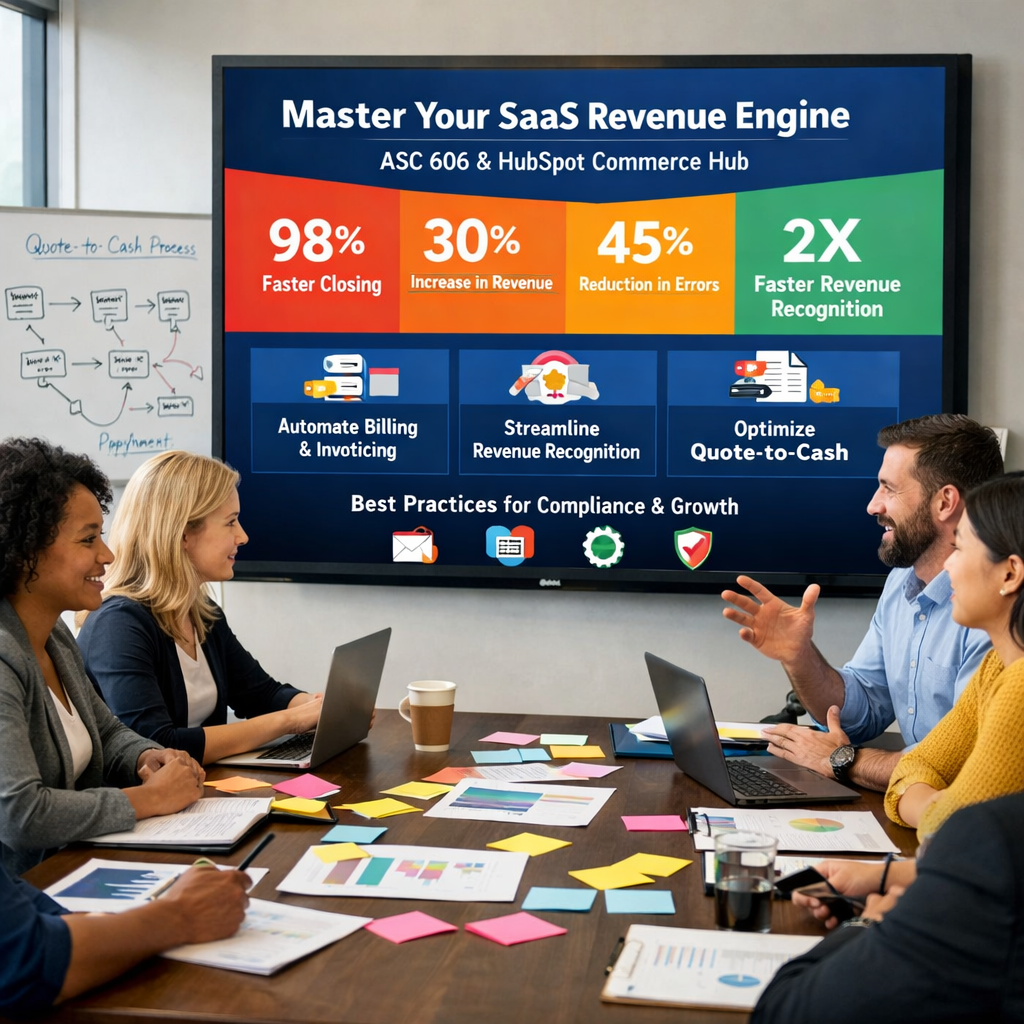
Today, we’re breaking down the essential SaaS accounting best practices and why HubSpot’s new Commerce Hub is the ultimate game-changer for SaaS companies looking to streamline their Quote-to-Cash process.
The ASC 606 Challenge for SaaS
ASC 606 changed the game by requiring companies to recognize revenue when a service is transferred to a customer, not just when the cash hits the bank. For SaaS, this means:
- Identifying Performance Obligations: What exactly did you promise?
- Allocating Transaction Price: If you sold a bundle (e.g., implementation + subscription), how is that value split?
- Recognizing Revenue Over Time: Distinguishing between bookings, billings, and recognized revenue.
- HubSpot Commerce Hub gives you the options of, not only deal amount, but also Quotes, Invoices, Subscriptions, and Payments giving you a Revenue pipeline in addition to the Sales Hub Deal Pipeline.
- This Revenue pipeline keeps track of:
- New payments each month
- New subscriptions each month
- Churned subscription projects
- Net-retention revenue
- Gross-retention revenue
- and MUCH much more!
The Best Practice: Move away from manual reconciliation. If your sales reps are quoting in HubSpot but your billing happens in a silo, you’re asking for data integrity issues that will haunt you during an audit.
Why HubSpot Commerce Hub Beats the Competition
For years, SaaS companies felt forced to use "bolt-on" tools like Maxio, Chargebee, or Stripe Billing to handle recurring revenue. While those tools are powerful, they create a "Data Silo" problem.
Here is why HubSpot Commerce Hub is now the superior choice for B2B SaaS:
1. One Unified Source of Truth
With Commerce Hub, your deal flow, proposals, quoting, contracts, and payments all live in one tool. There is no "sync" required because the data never leaves your CRM. You can compare deal amounts to invoices vs. paid (realized) revenue in real-time.
With Maxio or Chargebee, you are limited to tracking subscriptions created from the Maxio/Chargebee to HubSpot integration. If you create a subscription or invoice in Maxio or Chargebee, it will not sync the other way without an expensive built custom integration (trust me, we've done it more than a few times).
2. Advanced Subscription Management
Unlike basic payment processors, Commerce Hub allows you to:
- Track, Pause, and Resume: Handle customer lifecycles without manual hacks.
- Upgrade/Downgrade: Automatically adjust billing when a customer scales.
- Metered Billing: Configure usage-based pricing that updates subscriptions dynamically.
3. Native SaaS Metrics (No Spreadsheets Required)
Commerce Hub doesn't just collect money; it provides the insights you need to scale. You get native reporting on:
- Monthly Recurring Revenue (MRR)
- Net Revenue Retention (NRR) & Gross Revenue Retention (GRR)
- Churn Rates: Identify exactly when and why customers leave.
- One-Time vs. Recurring: See how your professional services fees compare to your core software revenue.
4. Automated Invoicing & "Autodraft"
The "Invoicing Gap" is where many SaaS companies lose 2-5% of their revenue. HubSpot allows you to use autodraft, which automatically drafts a payment, creates a paid invoice, and sends it to the customer. It’s seamless for them and hands-off for you.
HubSpot vs. Maxio & Chargebee: The "RevOps" Verdict
| Feature | HubSpot Commerce Hub | Maxio / Chargebee |
| Platform | Fully Native to HubSpot CRM | Third-party Integration |
| Sales Friction | Reps never leave the CRM | Reps switch tools or wait for syncs |
| Reporting | Billed vs. Realized Revenue in one view | Requires data export/BI tools |
| Implementation | Fast (days) | Complex (months) |
| Cost | Included/Seat-based | High monthly service fees + % of revenue |
| Stripe Integration | Built natively for Stripe or HubSpot Payments (a white label partnership with Stripe. | Adds a 3rd and 4th layer of complexity between Stripe, Maxio/Chargebee, HubSpot, and Possibly Quickbooks |
| Quickbooks Integration | Fast (hours) 2way DataSync. Only requires Quickbooks/accounting integration and nothing else | More complex and need to determine which tools to connect to Quickbooks. |
While Maxio and Chargebee offer deep financial "niche" features, most scaling SaaS companies find that the complexity they add isn't worth the trade-off. HubSpot Commerce Hub delivers 95% of the power with 0% of the integration friction.
Build Your Revenue Engine with Peddle
Transitioning your billing and revenue recognition to HubSpot isn't just a technical switch—it’s a RevOps strategy.
At Peddle, we help B2B SaaS companies centralize their customer data and revenue activities. We don't just "set up" HubSpot; we build a robust platform that scales with you, acting as your fractional RevOps team for the cost of a single employee.
Ready to stop chasing invoices and start scaling revenue?